Wednesday, 13 September 2017

The Challenges of Weather


We have lots of tools and machines at our disposal in order to maintain and present the golf course to its maximum potential. However something which is out of our control is the weather conditions that we face on a day to day basis.

This year has thrown up some very interesting weather patterns but overall the amount of rainfall has been very excessive, making our job even harder.

In an earlier blog I have talked about rainfall levels and the effect it can have on surfaces. The rainfall figures for this year make for interesting reading. Some months are way above the normal average when others are way below.
 

This chart illustrates the amount of rainfall and the number of days it has fallen
The rainfall has been excessive but the number of days of rainfall has been, in some cases, quite low in comparison.
For example, if you look at the chart above, the highest month so far, March, recorded 163mm of rain over 17 days in the month. July, posted 132mm for only 2 days less.

So as we entered September the golf course was already showing signs of being wet underfoot after the main "summer" months of June, July and August totalling a massive 359mm of rainfall. That fell over just a total of 41 days.
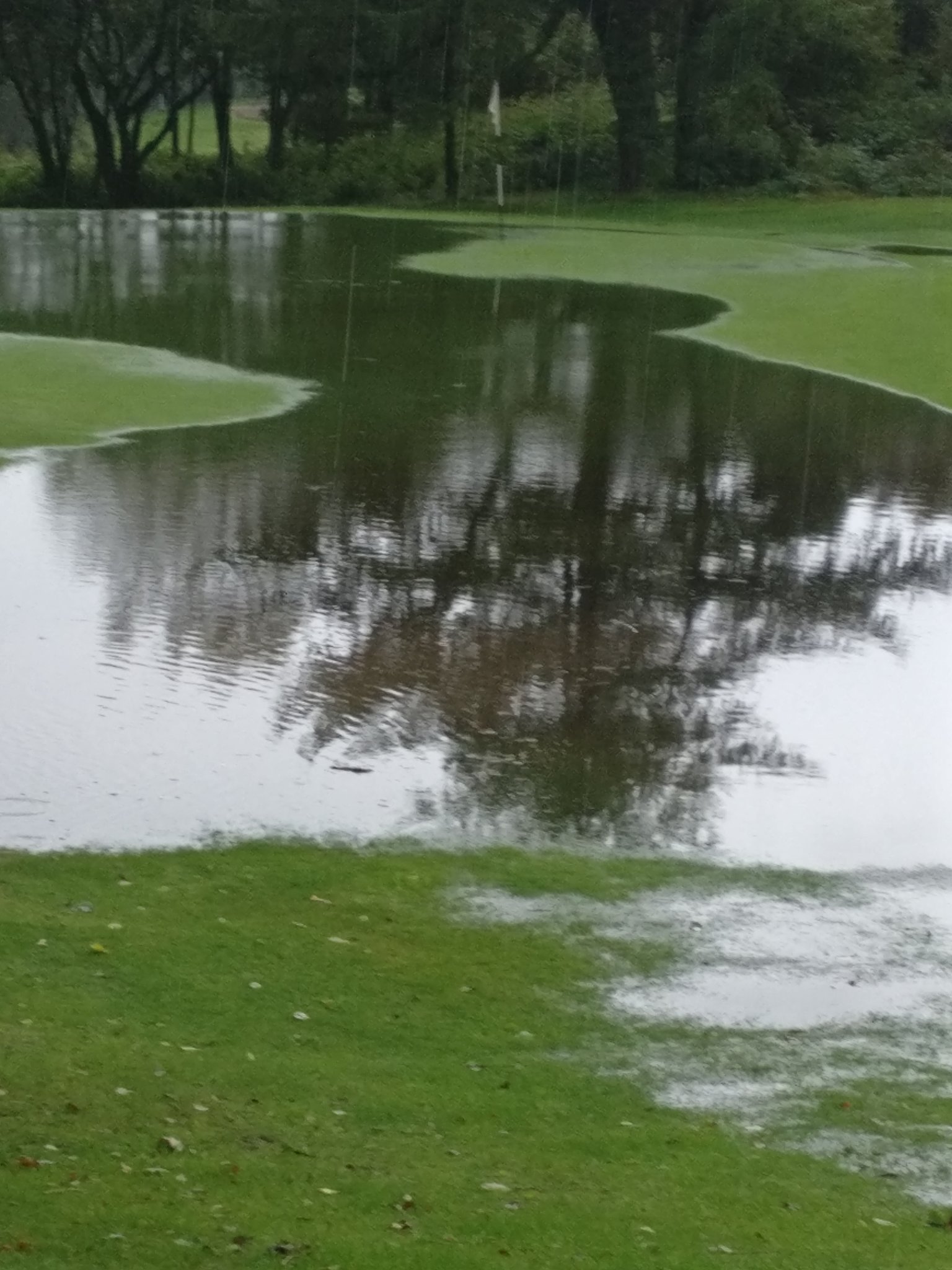
Ditch on left of 13th fairway burst its bank, resulting in the green flooding
So what we needed was everyone saying let's hope for an "Indian Summer". Unfortunately that's not been the case as, at the time of writing, we have had 111mm of rain in a 9 day straight period at the start of September. That is 13mm more than the whole of August.
 
As you can imagine the course has struggled to take this amount of water, especially the heavy downpours and we have had to experience some course closures. However, it has been very welcoming to see how the course has drained in many areas once the rain has stopped.

The greens remain firm and that is testament to the ongoing renovation work, most recently carried out in August. The more dressing we can put onto the greens, the firmer they shall be. This bodes well for the winter time and work will continue in this vain. The club have rightly continued to invest in as much dressing as possible for the greens to improve them to cope with such extreme weather patterns.


Greens Topdressing Applications

 
Over the last 5 years we have applied 640 tons of topdressing and that is one of the main reasons why the greens are the condition they are today.
 
 
Procore was used this week on the greens (this is the 12th tee!!)


This week the greens have received a needle tine to allow them to breathe after all this rain. It will help to shed the surface water and allow toxic gases to exit the rootzone. It is very important at this time of year to keep the surfaces as open as we possibly can to help prevent disease taking hold.
 

18th Green after a spike and cut

The greens were handcut also for the first time in a long time. The weight of the machine is a lot lighter on the green surface and also it is safer than driving the triple mower around in the very wet conditions.
  
Also we have had several pleasing comments to say how surprisingly dry the course is considering the amount of rain. The fairways have been spiked and scarified during the summer period and they are receiving the benefit from that. This work will continue in the Autumn.
 
To make the fairways even better, like the greens, in an ideal situation we would like to commence topdressing the fairways. Obviously this would come at a significant cost due to the size of the area needed to be covered. However in the long run it would mean the fairway condition would improve drastically, resulting on firmer, tighter cut surfaces in a condition to be played all year round.


Youtube video: Look up "Verticutting and topdressing fairways"


So we will continue to present the golf course to our best ability as we head into Autumn. The temperatures are still reasonable and hopefully with a bit of luck from above we can all look forward to the golf course being back to its best as soon as possible.


Monday, 14 August 2017

August Greens Maintenance

GREENS RENOVATION

Last week all the greens were renovated with the staff carrying out around 100 hours of work on the surfaces. The tees were also dressed and sprayed for weeds. The week before we got started the greens were liquid fed to aid recovery and the Air2G2 machine was used on the greens to blast air into the subsoil, fracturing the soil and allowing air and water to move more freely down below.
 
All the greens were spiked with the TerraSpike machine, using 12mm solid tines down to a depth of 175mm. The greens were then heavily topdressed and that dressing was brushed in. Then, the greens were spiked again using the Procore with 8mm worn tines down to a depth of about 60mm. Another dusting of sand was put on and then the drag mat was used to help smooth out any discrepancies. We also added some bent seed into the dressing.
SQUARE SPACING
 
 
The vast majority of this work was carried out over two days, which meant some morning course closures, but this definitely went some way to help the Greenstaff achieve their goals.
TOPDRESSING
 
There are always two sides to the renovation work which we feel is very necessary in trying to achieve the best quality surfaces possible all year round. Firstly, there is the disruption to the golfers. We fully appreciate that many golfers cringe at the thought of maintenance being carried out on the greens. However, without sound management the greens would go into a state of decline which can be difficult to get back. There will always be certain conditions which mean the greens are not at their best for a short period of time following the work, however they will be much better in the long term. 
BRUSHED IN
 
Secondly, it is now proven that the best time of the summer to carry out the main maintenance procedures on the greens is in August. Many, many golf courses up and down the country are now following suit (and those that are not wish that they could). The soil temperatures are at their greatest, weather dependent, and so the recovery of the surfaces will be at its fastest.
 
As you can see from the pictures it has only taken a few days to recover and from now on the greens will return to the good condition that they were before we started. This also means that the greens will be firmer and drier going into the winter months so that golf can be played on them all year round.


FEW DAYS LATER


The greens have also received a liquid treatment consisting of phosphite and a general soil conditioner. This will help the greens to recover and fight off any disease which may be lurking after all the disruption. We will continue to manage the greens so that the disruption is kept to an absolute minimum and the surfaces are back to their best as soon as possible.
 
LIQUID FERTILISER

Monday, 17 July 2017

July Update

As I type the sun is shining and the wind is drying out the course nicely. The weather recently could be described as a mixed bag. We have had bright sunshine, cold winds, torrential rainfall and three recent play suspensions for heavy fog, in July!!
 
What this means for the playing surfaces is that they don't really know whether they are coming or going. The greens are either, cold, burning up, drowning in rainfall or somewhere in between. So it is a fine balance to try and keep everything in the best possible condition.
 
 
Fog over the 2nd green
 
The team are all working extremely hard to try and maintain the course to the highest possible standard. We are trying to keep on top of things as much as possible which is difficult in a busy calendar for golf play. There has been some recent nice comments from members and visitors regarding the course condition and we are thankful for that.
 
The greens are performing well and the little and often approach to topdressing and feeding is working well. The new sprayer is coming into its own and making light work of what we ask of it. We are trying to maintain a quick pace throughout this busy period with lots of important competitions and knock outs being played. We can achieve this through double cutting the greens and using the iron too. It is very time consuming but the results are there for everyone to see. We are monitoring the speed so that we can strike a happy medium between having a good pace for general play, but not going to quick that the pace becomes unplayable.
 
The tees have never looked as good as they do now and again that is down to a lot of hard work. Heavy fertiliser, a growth regulator, brushing and cutting regularly have meant that we have been able to present a better surface. The height of the tees and approaches has been brought down as low as 8 mm. The fertiliser helped the tees to grow very strong and with the use of the growth regulator, the top growth is controlled, enabling the tees to thicken up. Regular brushing has meant we could stand up the coarser grasses to achieve a nicer cut. Regular sharpening of the cutting cylinders has also helped.
 
Tees and fairways improvement
 
Having invested heavily in the equipment this spring, we can already see some good improvements on the fairways. They are being cut as regularly as time allows and for the first time in my tenure they have been fed. Having spiked them in the spring, the fairways were scarified using the new TerraRake, which helped to pull out a lot of thatchy material. This will be done again at the end of the summer. This process helps the fairways to breathe and produce a better surface. There is much work to do on the fairways but we have made a decent start. We have sprayed a soluble fertiliser and iron to help give the fairways a better appearance and this will be applied again shortly.
 
1st fairway definition
 
At the end of the summer the deep rough areas will be cut down again and collected. Then we will use the rake again to pull more thatchy material out so that the rough starts to thin out. The eventual aim is to achieve a wispy rough where you can walk in and find your ball without a problem. A long way to go but it can be achieved.
 
Off the course we are busy planning budgets for next year and looking at what jobs we are going to carry out during the winter period. This will be updated at a later date.

Saturday, 10 June 2017

Course Update

As we have entered June the course has now come to life with strong growth all over. It certainly took its time as the cold dry late spring meant that the growth spurt you normally get in spring was late in coming.


Michael cutting greens
Strong growth on the greens has meant that their pace has come into question as we have struggled to keep it fast enough for many of the members. It would be nice to work on the greens in the afternoons, giving a dry cut can make such a big difference. However with many a midweek competition and matches going on this is not always possible. With the strong growth the greens slow up during the day, but now the spurt seems to have subsided which means we should be able to control a better pace. Topdressing in the form of light dustings will be applied as regularly as possible to help with smoothness.  You can read a more detailed piece regarding the difficulty of maintaining pace at the link below
 
 
The tees also have been growing really well, the fertiliser having kicked in well. The idea was to try and thicken up the tees so that we can provide a much better quality of surface. A growth retardant can be used to help thicken the sward and keep top growth from becoming out of hand.


Strong growth


We have started to scarify the fairways using the new tractor and Terra Rake. This works in a similar way as your garden rake would when you scarify your lawn, just on a larger scale. The debris pulled out is blown away into the rough by the new blower and if there is plenty of it we can pick it up using the cut and collector Super 500.
Scarification


Spring growth
Strimmed ready for spraying
It is difficult when trying to concentrate on all the larger areas of the course and its excessive growth to make time for some other areas such as bunkers, trees and ditches. We try and work on these areas as much as possible to keep up with presentation and last week all the ditches were strimmed inside and outside ready for weedkilling.
  
Over the next week or so the fairways will continue to be scarified and the bunkers will all be looked at for strimming, weedkilling and also topping up with new sand. We have a priority list that we can refer to with the budgeted amount of sand.
 
 
Saturday competition cancelled


We need the weather to play ball a bit more as this week has been very difficult to maintain the golf course. At the time of writing we had 100mm of rain from the start of the week, which made at least two days just about impossible to carry out any course maintenance. During this time, machinery was serviced and sharpened and the barn tidied. The staff will continue to work hard to present the course as best as possible.


Friday, 19 May 2017

Maintenance Week

This week the staff have worked hard to perform as much tasks as possible, despite over an inch of rain falling on the course. This put paid to any chance we had of coring the greens. Before the week started we looked at the forecast, the soil temperature, the golfing calendar and the expected recovery time and we took the decision that hollow coring was not the option at this time.
 
We tried to use the weather to our advantage as we knew that the heavy rain would wash in the topdressing nicely. So on Monday we solid spiked the greens with 10mm wide tines (on the new Wiedenmann GXi8) down to a depth of 6 inches. We followed this up on Tuesday by firstly brushing the greens with the sweep and fill brush to stand up the grass. Then they were cut before topdressing commenced. The topdressing went on fairly heavy in the rain so much so that when we were dressing the bottom four greens, the dressing on the top greens had almost been washed in already. This meant we were able to put more on straightaway. The dressing was then run over using a dragmat to help with smoothness. 
 
On Wednesday and Thursday we then spiked the greens again with the Procore using 8mm tines down to 4 inches. This was followed by more dressing, matting, brushing and cutting. On Friday the greens were cut and ironed to help bring the pace up a touch as carrying out this kind of work always drops the pace off. We have managed to put around 25 tons of material onto the greens this week which is a really good effort considering the challenging start to the week and the lack of growth. Soil temperatures are now up again to a respectable level and so with another feed due on the greens next week, we should see an improvement in their playability once again. Regular light dressings, brushing and cutting will be carried out to inprove smoothness.
 
Also this week we have took the opportunity to spike all the tees and approaches with the 10mm tines as well as fertilising the tees with a slow release, season long granular fertiliser. The fairways and roughs were cut too to help improve presentation. As growth continues the golf course will continue to come to life.

Saturday, 6 May 2017

Cold Spring Course Update

As we enter May you would expect the normal spring growth kick to be well underway by now. However that is not the case up on the course at the moment as a week of extremely strong easterly winds has played havoc with both playing conditions and any potential for decent growth. Patience is really the key at the moment for all concerned.

The greens have really suffered in these conditions as they have dried out and firmed up significantly. With a mixture of a lack of rainfall together with heavy winds, there is no wonder that there has been a significant lack of growth. We have fertilised, topdressed, brushed and generally done everything we can to assist making decent putting surfaces and now we just need a bit of help from the weather to help us on our way.

We have been using the irrigation system on a regular basis, however there is an issue which is affecting the bottom part of the course, specifically greens 4,15,5,14,3, and 13. This issue should be sorted out in the next few days. These greens haven't received the same kind of moisture inputs as the others which again affects their appearance but this is a short term issue. The winds have really affected the direction of the spray from the sprinklers. I'm sure you will notice from the direction of the winds how some greens will be dry in one area and normal in the other. Some bunkers have received a real soaking due to the wind strength taking the spray away from the designated area.

Another negative of the heavy winds this week is that we haven't been able to use our new sprayer (other to spray a bit of water on the bottom greens) as there was no way we could control the chemical feeds being applied to the surface. The winds are due to die down Sunday and therefore the sprayer will be used next week.

Another hot subject matter at the moment is the bunkers. Whenever we add new bunker sand to the bunkers there is always comments about too much sand or the wrong kind of sand. I can assure you that the sand recently added is exactly the same consistency as the previous stuff. The problem with new sand is that when it is powder dry or soaking wet it doesn't perform to its capabilities. It just needs a little more time to settle.

http://weather.headlandamenity.com/2017/05/may-2nd/   

I have attached a link to an interesting blog which goes into the lack of growth and moisture in more detail. It shows in greater detail the struggle many golf courses throughout the country are facing.

As I said at the start, patience is the key...

Wednesday, 1 March 2017

Winter weather disruption

As you can see from the chart below we have recently had some significant rainfall and stormy weather which has hindered what we have been able to achieve during this winter period so far.

We had planned to finish off some of the winter work in areas that had been started, such as the 1st and 14th holes. However, with all this rainfall flooding the golf course we have not been able to work on those areas for fear of causing further compaction and making more of a mess than is absolutely necessary.


Rather than the rainfall be fairly consistent, as you can see we have had three main rainfall timeframes all lasting approximately 9 days totalling 203mm. This has had a serious effect on ground conditions and playability. After a week or so of drying weather the heavens reopen and bring us back to square one. This has meant course closures and/or the use of temporary greens at times, but I’m sure now you can understand why.


As well as the rainfall, we have had significant damage from Storm Doris, which caused several pine trees to fall, split or lean to an extent that were deemed unsafe. These trees have been chopped up but, due to the ground conditions being what they are, we have left them in situ for a short period until we can remove them via trailer or chipper. Hopefully the rest of March is kinder to us so that we can continue our preparations ready for the new season ahead.