Monday, 19 March 2018

Winter Update

The weather continues to play havoc with our on course works with another load of snow dumped on the course, preventing us from carrying out certain tasks. Lots of the work already carried out is at its final stages, so everything is in place ready to finish the jobs as soon as the course is fit to do so.

Storm damage at the 4th

The drainage on the 1st, 9th and 10th is ready for turf, which has been ordered. (Turf suppliers are also feeling the brunt of the weather too, as you can imagine). The double bunker on the 9/10th has been filled in and shaped ready for turf too.


New shaping underway at 9/10th bunkers

All the tee bank steps on the 3rd, 4th and 7th tees have been prepared ready for turf. The old sleepers were removed, the area rotavated and new rootzone added and shaped.

Steps at the 7th Medal Tee


The bombhole to the right of the 15th fairway has had soil added and shaped ready for turf. Drainage runs through the middle of it and joins into a culvert which runs down to the 5th.

15th Pit shaped for turf


The area behind the 5th tees has had soil added and shaped. This area will have heather planted on it, transported from elsewhere on the course, as well as new turf.

Mound shaping at the 5th Tees

This week we will also be concentrating on removing all the tree stumps with a hired stump grinder. Although a slow process, the light and air movement now created from removing the trees will be of benefit to the surfaces in the long run.

The greens have received a granular fertiliser to help with their nutrition and they have responded well to it. The scarifying plan is currently on hold due to all the works underway and the weather problems, however the tining and dressing will commence as soon as possible.

The rest of the time when not completing winter jobs will be taken up with tidying the course in preparation for the opening of the upcoming season.

Thursday, 1 March 2018

Winter Course Update

"The Beast from the East" followed by Storm Emma have certainly brought some very cold and wintry conditions to both the course and the whole country. Usually this means we have to change our plans from what we thought we would be doing out on the course, to actually what we can do.
 
2nd hole at dawn
 
The planned renovations on the greens, which consisted of scarifying the top 20mm or so, followed by solid tining and topdressing has had to be postponed for obvious reasons. We will still need to carry this out, but it will have to wait a while until conditions approve.
 
Scarifying to be carried out soon
 
Also, having the course full of snow and frozen ground, the drainage work at the 9th and 10th has also had to be stopped for a short while. Most of the major works in that area has been done but there is lots still to do to complete the process.
 
One of the drainage ditches going in

 
The trenches dug across the 9th fairway and in the 10th rough have all been piped and stoned. These will be filled up to the top with rootzone and then turfed. The trench on the 9th fairway has had added pipework installed which will be fitted straight into the main culvert running across the fairway.
 
A sample of the thatchy turf found in the wet rough areas with clay underneath

 
A sample of some of the large rocks found under the surface when digging
 
The area near the trees on the right of the tenth has had drainage installed. This has gone straight through the double bunker, then into the main trench across the 9th. The bunkers have been filled in and will be shaped and turfed to contain the original design features.

 
Although all this work is being carried out, the condition of the very heavy clay subsoil will dictate that it needs much more work in terms of aeration and dressing in the years to come to help the drainage to work fully. However much of the standing water will hopefully find its way much more quickly to the culvert below. There is a lot of compaction in the whole area due to the amount of traffic that it receives and we must spread the wear by driving and walking in different areas.
 
High traffic area means much compaction, especially on clay
 
Since the turn of the year, members of the greens committee and greens staff carried out two course walks, front nine and back nine to discuss areas of the course that need to be finished, or problem areas that need solutions as quickly as possible. When the weather is like it is currently, it is a chance for us to try and work through some of these areas so that the playability for the members and visitors is at its best possible level when you can start playing again.
 
Right at the very start we focussed on first impressions and it was clear that standing on the first tee you are not able to see a pin on the right hand side of the green, or the right hand greenside bunker due to the trees that are surrounding the pond. Players driving the ball to the right have no idea where the ball is landing as the trees block out the landing zone. It was deemed necessary to take out some of the trees to give the player a much clearer view of the hole. This work has been started and we will keep cutting back until we can see the bunker from the tee.
 
The right side of the hole has closed in so you can't see the green

Trees being removed around the pond
 
From the second competition tee, it was clear that overhanging branches were interfering with golfers' ability to drive down the left of the hole. Those branches were removed, along with a couple of dead trees to aid play in that area.
 
View from second tee without the interference
 
I'm sure you will have all seen by now the trees and scrub taken out between the left of the 5th and the 6th holes. Having carried out the work it came to our attention that many times buggy users had caught a particular tree that was leaning over the path leading to the 6th tees. This became a health and safety issue and so it was decided to take it down.

Tree at the path near 6th tee

Also during the course walk, when stood at the back of the 14th tee on the left hand side, it was clear that no tee shots could be played from the very left, due to overhanging trees on the out of bounds line. We have removed a couple of trees to improve the sight line. There was much discussion about the 14th hole in general and how we can improve matters and several ideas were brought up. However for now no major works will be carried out until further planning is discussed and budgeted for.
 
The dangerous trees that were leaning near the 16th tees have been felled and removed. There are still some stumps to come out but at least now the area has been made safe. There is also a snapped branch further up near 17 which needs to be dealt with to make that area safe. This will be done as soon as possible.

Area to left of 16th with dangerous fallen trees
 
The area behind the 5th tee has had some material placed there in order to carry out some shaping. This will then be added to with topsoil and turned into mounding so that heather can be imported from other areas of the course and planted there.
 
Recycled material used to create mounding

Early shaping before new material added
 
The staff are working hard to carry out all the tasks needed to be finished, sometimes in very poor, wintry weather conditions so that our focus can turn towards the course in general and preparing it for the upcoming season. Hopefully we will have a drier year and we can all look forward to forgetting about this winter in a hurry!


Saturday, 27 January 2018

Trees and Turf Quality

Trees and Turf Quality
There has been a lot of debate recently with regard to the use of trees on a golf course and recently an email was sent out to all the members explaining some of the main reasons why trees are sometimes removed.
 
The purpose of this blog is to explain in more detail what effect trees have on the reduction in turf quality and give solutions to the problems. It is certainly not an instruction to take all the trees out on the course, it is simply some information to digest, that by carefully planning some work around the course, the quality of the holes could be improved if so desired.
 
Just to explain in full, trees are a major cause of poor turf quality on many courses up and down the land. There are four main areas where the negative impact of trees can be summarised, and they are:

·         Shade
·         Poor Air Circulation
·         Tree Root Competition
·         Interfering limbs and branches
 
 
Shade can harm greens and tees, causing frost to stay longer and disease to form
 
 
Shade
This is probably the biggest cause of turf weakness on a golf course. If you combine shade with golf traffic from buggies, trollies and machinery, the results can be very serious. The grass plant needs light to photosynthesize and produce food to grow and regenerate. When turf sits in shady conditions the food sources are depleted and it becomes too weak to recover from traffic.
 
Shade on 14th green. As he sun comes higher and further round the shade cast by the trees develops all over the par 3.
 
There is also plenty of evidence to suggest that certain diseases, such as Fusarium, favour shady conditions rather than out in the full sunshine. Greens and tees are very susceptible to damage as they receive a lot of traffic condensed over a small area, but also rough areas which receive a lot of traffic (on 5 and 14 for example) can also suffer.
 
Shade on the right of 5th. Another area of very poor quality turf
 
The lack of direct sunlight on any turf area also prolongs any potential drying out period after rainfall. This leads to greater disease activity and increased soil compaction.
To overcome a shade problem, it may be necessary to remove canopy and understory trees to increase the chance of sunlight hitting those areas.
 
Poor Air Circulation
Another consequence of too many trees in close proximity to important play areas is poor air circulation. In areas such as greens and tees where air is poor, the temperature of the air is usually higher, and usually little or no breeze is available in the area. Also, soil temperature and soil moisture levels tend to remain higher for longer periods due to the lack of good drying conditions.
As a result of these factors, disease activity, heat stress and soil compaction effects are common in such areas. As with shade, all these factors favour Poa annua taking over, a grass species which always performs poorly during stress periods.
 
A typical example of damaged and fallen trees in the woodland


The key to resolving problems with air circulation is to open passageways for air to move through the area. Removal of shrubs and understory trees can significantly improve the situation while generally thinning the canopies can also be of benefit. Removal of larger trees, especially those that block the prevailing winds, can prove very helpful if smaller measures fail.
 
Allowing air to flow through to bottom of course, clearing out the dead or decaying trees
 
Shade and air circulation problems usually go together, but this is not always the case. For example, some greens or tees may well receive full sunlight throughout the day, however they may well be suffering from poor air movement. This is particularly true on poorly drained soils, and large pockets of this golf course is built on heavy clay. So, each problem area has to be looked into on its own merit.


Poor quality growth and lack of previous tree management programme
 
Tree Root Competition
One of the main hidden (and sometimes clearly visible) dangers of trees is the effect of their roots on the turf nearby. Trees and turf both absorb water and nutrients through their roots to live and grow. And like turf, the roots of trees are mainly active and located in well aerated areas of the soil profile. In other words, turf roots and trees roots can be in direct competition for any water and nutrients, and usually it will be the turf that suffers during periods of weather stress.
 

Poor quality tree with visible tree roots


A way to reduce or eliminate this tree root competition is to mechanically prune the tree roots. This is normally done around greens and tees, but larger scale areas could also benefit if the need arises. There are various machines available to carry out this kind of work and they can be hired in. It would be recommended to carry out this kind of work every year or two and many golf courses have adopted root pruning as an annual practise in those areas of need.
 
Interfering Limbs and Branches
Maybe you are wondering how branches or parts of trees that interfere with a golf shot may cause problems to the turf quality, but this is exactly what happens on tees. Trees planted years ago, either next to a tee or down the fairway, can eventually grow to the extent that their limbs interfere with a tee shot. (A perfect example of this right now is the right hand side of the 15th tee)
When playing from the affected tee, golfers compensate by teeing up on the opposite side of the tee. As a result one side of the tee receives most of the wear and the other receives less and less play. This can affect the playing quality of the tee. The side not used as much can develop thatch problems and the overused side can become thin of grass cover, weak and then dominated by inferior grass species.


6th Tee clearing on the left and visible overhanging branches on the right
 
Rather than trying to force growth on the tee or spending extra time and resources on trying to improve playing quality, tree work is the best solution in the long run.
 
Summary
Trees greatly affect the turf quality on the golf course by the shade they cast, the air circulation they block and the roots they produce. They can also reduce the useable area on a tree by maybe 30-50% by producing limbs that interfere with play on a side (or both sides) of the tee.
When planting trees on the course, great care must be given to the planning of where the trees are to be planted. For our established trees, a good programme of tree removal and branch thinning would increase sunlight penetration and air circulation, and limbs can be removed to allow the full use of tees. Root pruning should also be considered for the future. It is very clear that although many trees were planted over the last 30 or 40 years, there has been no tree management in place for their future welfare. If there had been a 5, 10 and 15 year follow up regime, we probably would not be facing the issues we have now and the golf course would be better for it.
The effects of trees can cause unwanted stress to turf which may be already suffering from traffic, extreme weather and other issues. By carefully considering the above, it will hopefully be possible to improve the health and playability of the turf, especially where trees are an integral part of the area.


Friday, 22 December 2017

Winter Works

As we approach the festive period there is still plenty going on with the golf course. The growth has slowed right down but there is always something to do. We have been concentrating on keeping the greens trimmed and as healthy as possible, fixing drainage issues and carrying on with tree work.

14th Xmas Trim

The greens are looking healthy as we head towards the new year and we have just given them a final cut before Christmas. We will keep an eye out for any disease as there is not much sunlight at the moment with all this fog and humidity is very high, meaning disease pressure is high.

Collapsed Culvert on 10th Fairway

There is much talk in the club about the constant wet conditions over the 10th, 9th and 1st fairways. We inspected some areas on the 10th and found that the culvert across the fairway was collapsed and not able to take the amount of water coming round from the ditch beside the 10th green.

Flooding on 10 heading for 9th
Therefore we dug out the culvert and placed new pipework in its place. This pipework will be able to take the volume of water much easier and will stop the flooding in that area. Much of the work was carried out during the very cold and frosty conditions to try and reduce the amount of damage to the surrounding areas. The pipework will be covered back up with earth and returfed as soon as conditions are fit enough again to proceed.
New Pipework on 10th
There are areas on the 1st and 9th which also require great attention if we are to solve the issues there. It is not just one problem but several separate issues that all need sorting. Plans are being put in place to achieve the best result possible for the removal of water on this part of the golf course.

Another area of the course which has caused issues all last year was the pit on the right of the 15th. We decided to take the same approach as the left pit and strip off all the old thatchy turf which was holding water so well. Once we had dug it all away it was clear to see that old drainage in the pit had failed and was not removing water as it should. There is a culvert running through the pit which exits to the right and down to the 5th hole.

Culvert in pit on 15th
We have installed new drainage to the pit, linking existing clay pipes and the remains of the culvert. This has been covered by gravel and the whole area will be soiled and shaped to make the most of the drainage. Turf will then be added.

New drainage in pit on 15th
One of the areas that was a cause of concern from a safety point of view was the trees overhanging the public footpath on the 11th hole. Members of the public had complained that they were nearly hit by golf balls flying left of the green with the golfers playing the hole saying they could not see anything of the path due to the tree cover.

Several trees have now been removed to make sure that the path is visible from the course. Further up by the 12th tee the trees will be thinned at their lower level to aid visibility.

Other works taking place have been painting tee markers and ditch posts ready for the new season, as well as carrying on with the all important sharpening of cutting units to help achieve the best possible presentation. The fairway units are currently being targeted.

On behalf of all the Greenstaff I would like to wish you all the very best for Christmas and we look forward to seeing you in the New Year. Merry Christmas.

Wednesday, 13 September 2017

The Challenges of Weather


We have lots of tools and machines at our disposal in order to maintain and present the golf course to its maximum potential. However something which is out of our control is the weather conditions that we face on a day to day basis.

This year has thrown up some very interesting weather patterns but overall the amount of rainfall has been very excessive, making our job even harder.

In an earlier blog I have talked about rainfall levels and the effect it can have on surfaces. The rainfall figures for this year make for interesting reading. Some months are way above the normal average when others are way below.
 

This chart illustrates the amount of rainfall and the number of days it has fallen
The rainfall has been excessive but the number of days of rainfall has been, in some cases, quite low in comparison.
For example, if you look at the chart above, the highest month so far, March, recorded 163mm of rain over 17 days in the month. July, posted 132mm for only 2 days less.

So as we entered September the golf course was already showing signs of being wet underfoot after the main "summer" months of June, July and August totalling a massive 359mm of rainfall. That fell over just a total of 41 days.

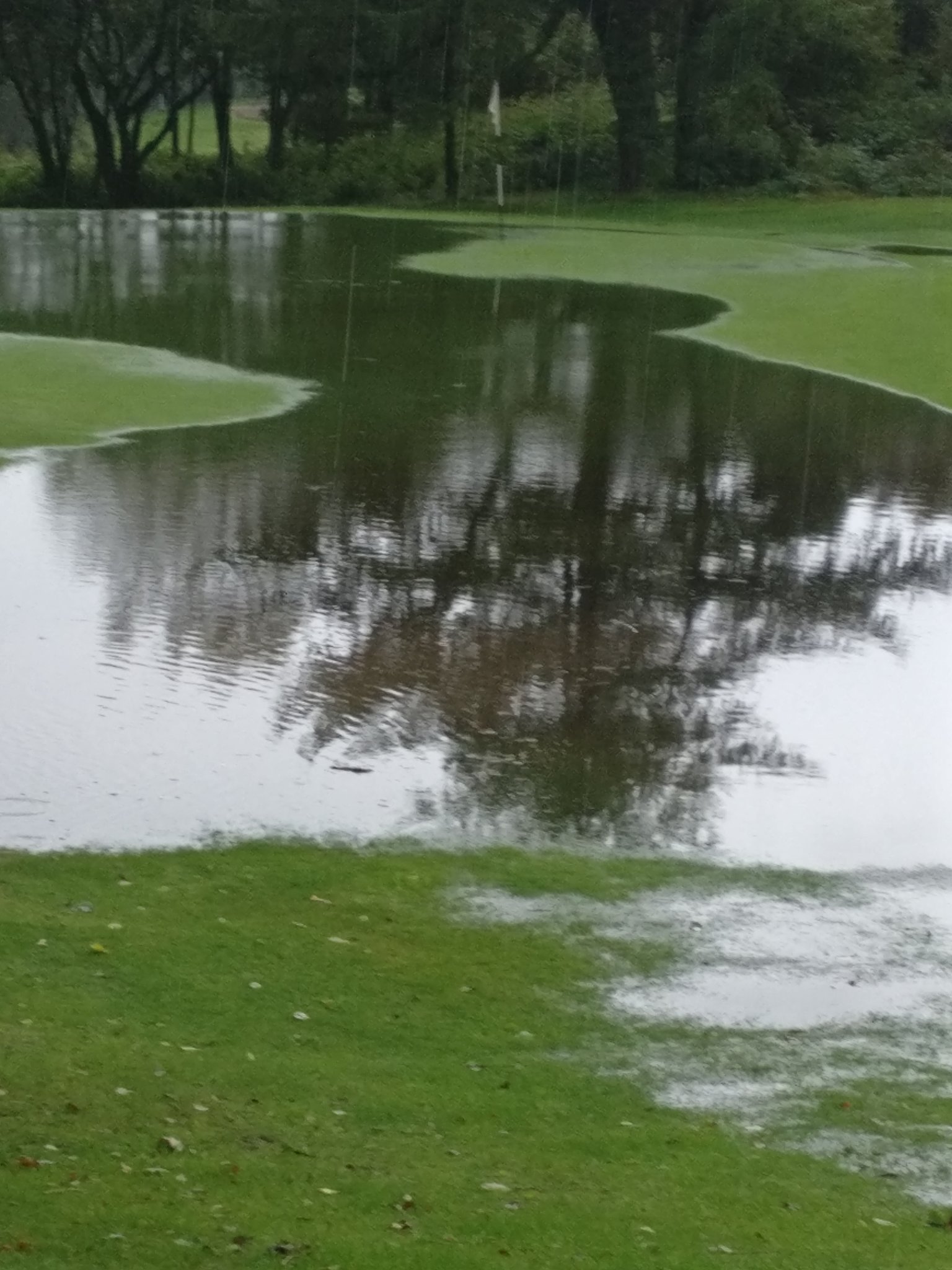
Ditch on left of 13th fairway burst its bank, resulting in the green flooding
So what we needed was everyone saying let's hope for an "Indian Summer". Unfortunately that's not been the case as, at the time of writing, we have had 111mm of rain in a 9 day straight period at the start of September. That is 13mm more than the whole of August.
 
As you can imagine the course has struggled to take this amount of water, especially the heavy downpours and we have had to experience some course closures. However, it has been very welcoming to see how the course has drained in many areas once the rain has stopped.

The greens remain firm and that is testament to the ongoing renovation work, most recently carried out in August. The more dressing we can put onto the greens, the firmer they shall be. This bodes well for the winter time and work will continue in this vain. The club have rightly continued to invest in as much dressing as possible for the greens to improve them to cope with such extreme weather patterns.


Greens Topdressing Applications

 
Over the last 5 years we have applied 640 tons of topdressing and that is one of the main reasons why the greens are the condition they are today.
 
 
Procore was used this week on the greens (this is the 12th tee!!)


This week the greens have received a needle tine to allow them to breathe after all this rain. It will help to shed the surface water and allow toxic gases to exit the rootzone. It is very important at this time of year to keep the surfaces as open as we possibly can to help prevent disease taking hold.
 

18th Green after a spike and cut

The greens were handcut also for the first time in a long time. The weight of the machine is a lot lighter on the green surface and also it is safer than driving the triple mower around in the very wet conditions.
  
Also we have had several pleasing comments to say how surprisingly dry the course is considering the amount of rain. The fairways have been spiked and scarified during the summer period and they are receiving the benefit from that. This work will continue in the Autumn.
 
To make the fairways even better, like the greens, in an ideal situation we would like to commence topdressing the fairways. Obviously this would come at a significant cost due to the size of the area needed to be covered. However in the long run it would mean the fairway condition would improve drastically, resulting on firmer, tighter cut surfaces in a condition to be played all year round.


Youtube video: Look up "Verticutting and topdressing fairways"


So we will continue to present the golf course to our best ability as we head into Autumn. The temperatures are still reasonable and hopefully with a bit of luck from above we can all look forward to the golf course being back to its best as soon as possible.